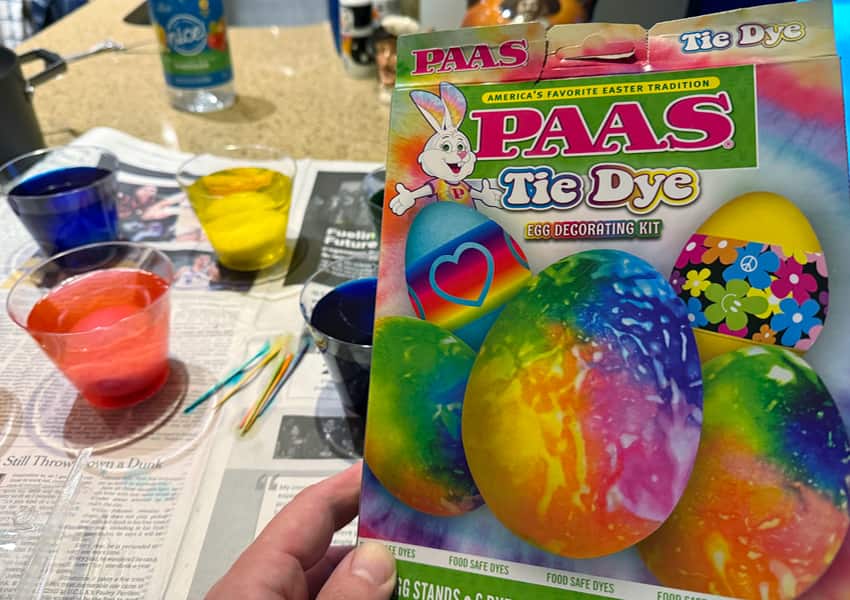
Easter is coming up this weekend, and I have to admit, I’m still a kid at heart and like to dye hard-boiled eggs for Easter. I usually get a PAAS Egg Decorating Kit, and this year decided to try a new one: the “Tie Dye” version.
It’s funny, considering how many years I’ve been buying PAAS kits, I never bothered before this year to try to learn something about the PAAS name … it turns out the PAAS egg dye product was invented in the late 1800s by an American named William Townley, who owned a drug store in Newark, NJ. Legend has it that Townley was measuring a powdered dye for a customer when he accidentally spilled some on his clothes, and frustrated by the mess, decided to create a better way to handle dyes. He somehow came up with the idea to compress the powdered dye into small dissolvable tablets. His initial foray into Easter Egg sets with these dye tablets became so popular that he saw potential for a larger business, and created the “PAAS Dye Company.” The name came from the Pennsylvania Dutch word “Passen,” which means Easter. This last statement, “Pennsylvania Dutch,” made me curious: what’s the difference between Pennsylvania Dutch and Netherlands Dutch? Pennsylvania Dutch are actually descendants of German-speaking immigrants who settled in Pennsylvania, and the pronunciation of “Dutch” is actually inaccurate, as the original settlers were probably referring to “Deutsch,” which means “German” in the German language.
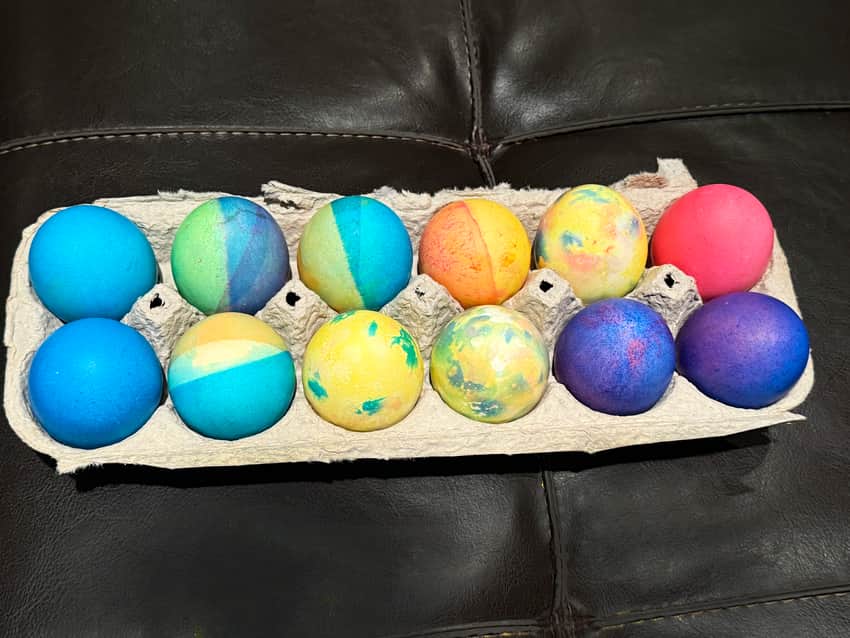
At any rate, I’m going down a rabbit hole of history here, let’s get back to my Easter egg decorating. The “tie dye” kit included a plastic mold and a small cloth, and the way it worked, I had to puncture holes into the mold, and then wrap the egg in the cloth, place it in the mold, and then use a dropper to inject dye into the cloth-wrapped egg and let it sit for a little bit. As you can see from my finished collection below, I did a few tie dye eggs, and then the rest were done the traditional way, by submerging them fully in the dye/vinegar/water mix.