
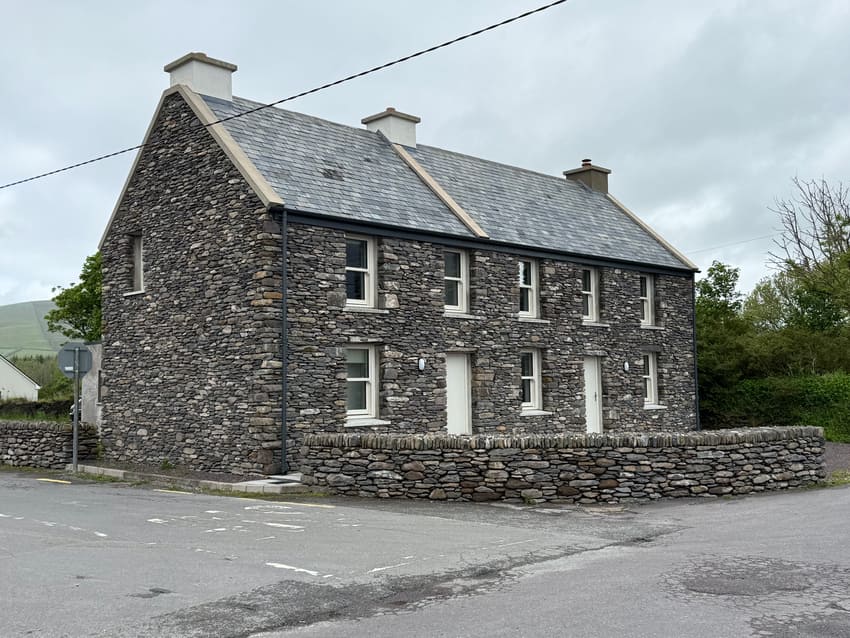
On my drive around the Dingle Peninsula, I passed through the town of Ard a’ Bhóthair, west of Ventry, in County Kerry. This stone cottage grabbed my attention, and I pulled over to take a look. I don’t believe it’s any sort of commercial building, but rather a two-family or duplex residential cottage, but that’s just my guess – as you can see, there’s no signage, no cars, no sign of activity.
I walked around to the side, and look at this wall: is this spectacular, or what?
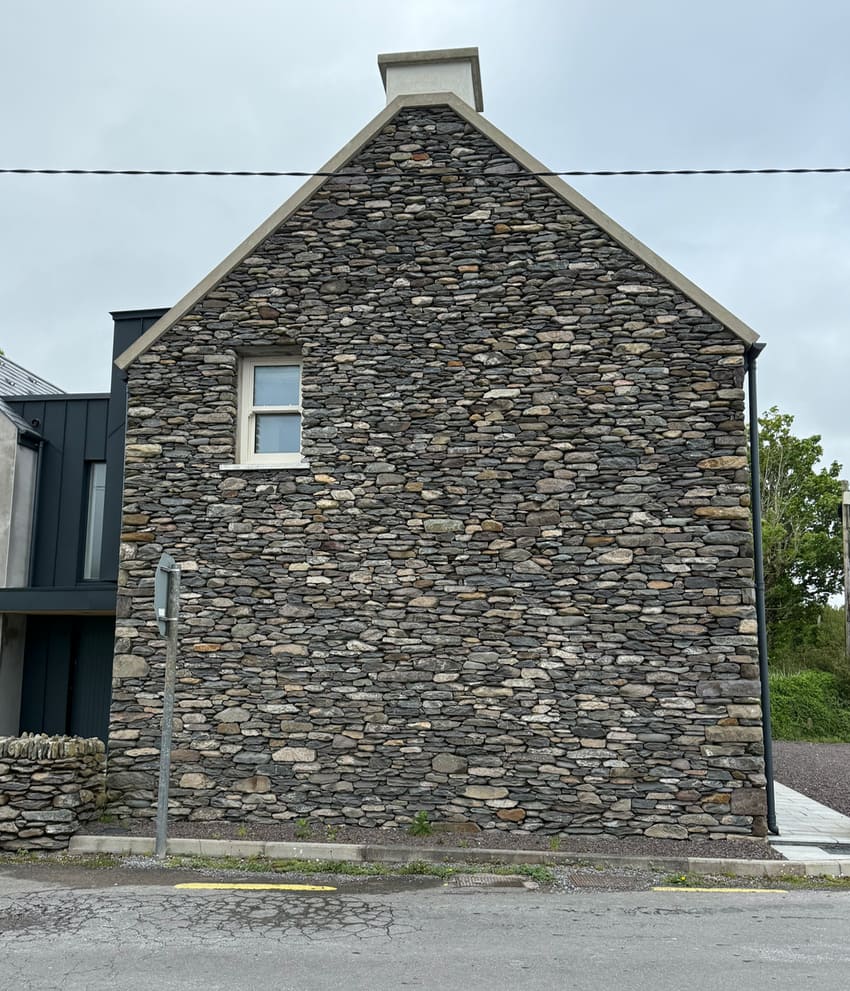
It’s like a stone puzzle, all the stones are different sizes and shapes (other than sharing a horizontal nature), and they just fit together. Amazing.
I wanted to learn more about how this is done, and this is what I found: it’s called “dry-stone/masonry walling,” and this building includes a slate gable roof, sash windows, and low dry-stone boundary walls lining the roadside.
Traditional dry-stone walling is described as one of the world’s oldest construction techniques, defining rural landscapes in Ireland (as well as other locations around the world) for over 5,000 years. It involves building stable structures entirely out of stone without any mortar, cement, or adhesive to hold them together. This is the part that I find amazing … there’s really nothing holding these together? The process of building a dry-stone wall is described as an exercise in physics, friction, and geometry.
Another interesting idea is that these stone walls were the result of people wanting to farm … in rocky regions of Ireland, farmers cleared millions of tons of loose glacial stone from fields in order to plant crops. Building stone walls for both living and to contain the livestock was the practical way to dispose of the debris while planning their farms.