
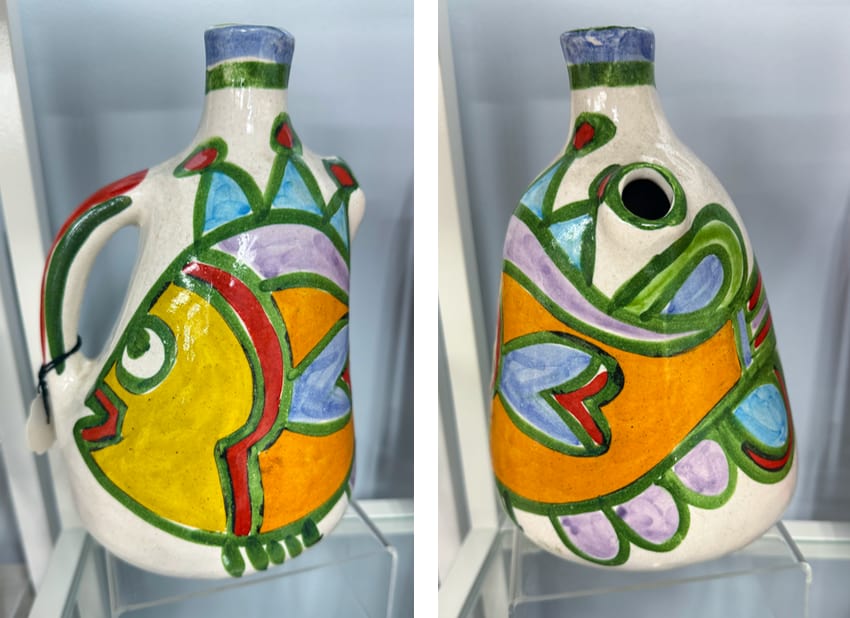
My girlfriend and I were on our way up to Rhode Island for the Newport Jazz Festival, and stopped by an antiques store in Connecticut for a look around. At one point she turned to me and said “I know you’ll like this one,” and pointed to the painted ceramic jug as seen above.
Sure enough, I did like it – the style of the fish and the jug itself were both appealing to me. A look at the attached tag gave this description: “Signed Italian artisan jug – Giovanni De Simone, 1930 – 1991, Sicily.”
I was not familiar with this artist, so I looked him up on the spot and was surprised to read that he was an “influential” Italian ceramic artist known for his hand-painted majolica pottery that “blended Sicilian folk art with a Picasso-inspired style.” Between my sincere interest in the piece along with this biographical info, I was intrigued, but then also read that he “studied with Picasso” or “worked alongside Picasso,” and that interesting connection made me decide to definitely buy the piece.
Now that I’m home and reading more about De Simone’s biography, it seems the Picasso connection is a popular myth as opposed to historical fact. According to clarifications from his family, including his wife and daughter, he was never a student of Pablo Picasso, nor did he work with him. It seems some art dealers, auction houses and online sites claim that he had an affiliation with Picasso, some even suggesting that Giovanni De Simone influenced Picasso’s use of color in ceramics. Oh well, even with these ideas debunked, I’m still glad I bought the piece, as I love it and know I’ll enjoy having it.
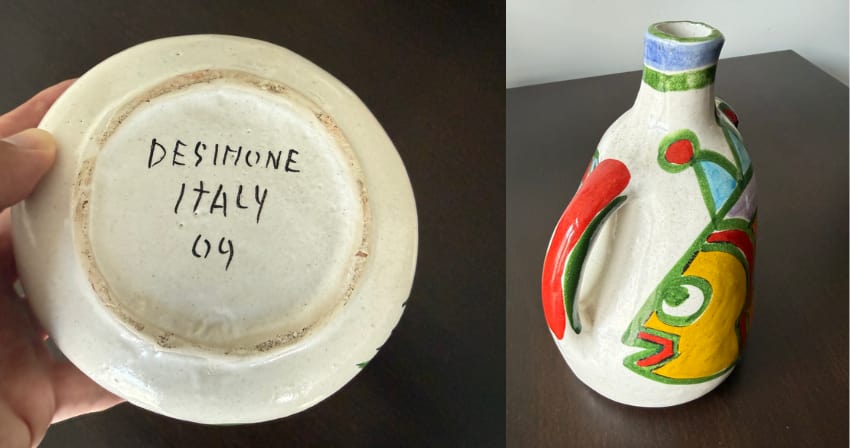
Here’s a picture of the bottom, which reads “DeSimone Italy 09,” which I initially assumed “09” referred to the date, as in 2009. But now I’m seeing another online reference that suggests that numbers on the bottom are not the date but rather a reference to an item shape code (as I can see other jugs or pitchers that have this same handle and spout configuration).
I’m not seeing much biographical info about Giovanni De Simone, but what I did find says he studied at the Institute of Art for Ceramics in Faenza, in the province of Ravenna, and in the 1950s he launched his studio “Majoliche d’Arte De Simone,” where he created functional dinnerware, serving pieces, tiles, and art vases using bold black outlines, bright primary glazes, and stylized depictions of Sicilian folk life, including the sun, fishermen, and abstract faces.
Considering the info found online about studying with Picasso was not true, one can wonder how much myth vs. fact there is about this artist, but another interesting item I found was that as a young child, he traveled with his family to Somalia. It is said that the vibrant and colorful African art and visual culture he encountered there deeply influenced his sense of form, color, and style throughout his career.